
Kari’s Tips #131: Your Inbox on Autopilot — Is Your Filing System Slowing You Down?

Your Inbox on Autopilot
Let's take a quick look at why your current filing system may be silently draining your time.
There’s a quiet thief in your inbox—and it’s not spam.
It’s the constant stream of non‑urgent emails that interrupt your focus, crowd your view, and pull you away from deeper work.
Newsletters. Promotions. Updates you want… but not right now.
If every message sits alongside the emails that actually require your attention, your brain treats them all as equally important. And that is where the overwhelm begins.
📏Why Outlook Rules Help You Breathe Again
Rules let you automatically move low‑priority emails out of your main inbox so you see only what matters when you sit down to work. Think of Rules as a digital gatekeeper: they quietly redirect information you do want, just not front‑and‑center while you’re working.
PART 1: How to set up a rule (quick):
- Right‑click a newsletter or non‑urgent email
- Choose Rules → Create Rule
- Choose Move to Folder
- Create or select a folder (e.g., “Newsletters,” “Reading,” “Later”)
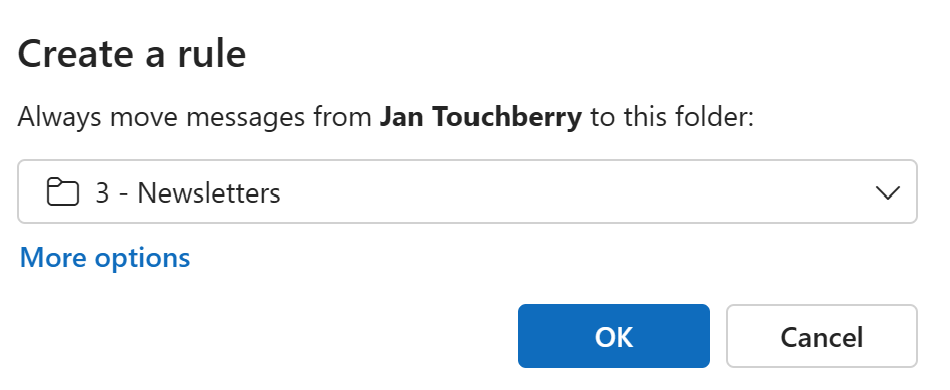
- Click OK
- Repeat for each newsletter/sender you want to include.
Every future email from that sender will skip your inbox and land where you want it—quietly, without the mental ping.
⚠️ A Rule Without a Plan Becomes Clutter
I have a major caution!! A folder only works if it has a purpose and a schedule behind it. If you move messages “out of sight” without knowing when you’ll check them again, all you’ve done is create another inbox—and an invisible inbox is even more dangerous than a visible one because you don't remember to check it.
Part 2: Make your Rule intentional
- Pick a review rhythm you can keep (e.g., Mon/Wed/Fri at 3:30 pm for 10 minutes).
- Add a repeating appointment called “Newsletter Sweep” to your calendar. Tip: this doesn't take much mental load so don't waste your best brain power on it.
- During that block, skim, save what’s useful, and delete the rest.
- Personally, I like to associate it with something fun like an afternoon coffee (habit stacking 🔗)
Why This Matters
You’re not deleting or unsubscribing from sources that help you—you’re simply removing them from your line of sight until you choose to engage. This is about intentional attention, not more organizing.
🗃️Filing Fatigue: The Hidden Cost
When most people hear “move emails to folders,” they picture dozens of folders. That used to make sense when volumes were lower and navigation was slow. Today, too many folders create friction:
- More decisions
- More clicks
- More searching
- More “Where did I put that?” moments
Linear filing doesn’t match the way Microsoft 365 works now. Rules are just the first step toward a simpler, low‑maintenance system but I am not advocating rules upon rules or folders upon folders. Rather a very limited number of folders. If you want to learn more - my course - Inbox Relief dives deeper.
Ready to Go Deeper?
If turning off notifications was step one…
And using Rules (with a review plan) is step two…
Then step three is designing a modern inbox structure that prevents filing fatigue altogether.
In my Inbox Relief Outlook course, I teach:
- A simple folder strategy that actually works today (and why most people are using the wrong one)
- How to keep your inbox clean without spending hours filing
- How to build an attention‑friendly workflow that matches Microsoft 365 as it is now
Your time—and your attention—deserve better than a noisy inbox.
